Reproducible research data analysis platform

Flexible

Run many computational workflow engines.
Scalable

Support for remote compute clouds.

Reusable

Containerise once, reuse elsewhere. Cloud-native.

Free

Free Software. MIT licence. Made with at CERN.

Examples
Get started
1

Structure your analysis

inputs:
files:
- code/mycode.py
- inputs/mydata.csv
parameters:
myparameter: myvalue
workflow:
type: cwl
file: workflow/myworkflow.cwl
outputs:
files:
- results/myplot.png
more
2

Select a REANA cluster...

$export REANA_SERVER_URL=https://reana.cern.ch/
$export REANA_ACCESS_TOKEN=XXXXXXX

...or install your own

# install kubectl 1.19+, kind 0.9+ and helm 3.0+
$sudo dpkg -i kubectl*.deb kind*.deb kubernetes-helm*.deb
# create Kubernetes cluster (or use your own!)
$wget https://raw.githubusercontent.com/reanahub/reana/maint-0.9/etc/kind-localhost-30443.yaml
$kind create cluster --config kind-localhost-30443.yaml
$wget https://raw.githubusercontent.com/reanahub/reana/maint-0.9/scripts/prefetch-images.sh
$sh prefetch-images.sh
# deploy REANA using Helm
$helm repo add reanahub https://reanahub.github.io/reana
$helm repo update
$helm install reana reanahub/reana --wait
# create an admin user
$wget https://raw.githubusercontent.com/reanahub/reana/maint-0.9/scripts/create-admin-user.sh
$sh create-admin-user.sh default reana john.doe@example.org mysecretpassword
more
3

Run your analysis

# create new virtual environment
$virtualenv ~/.virtualenvs/myreana
$source ~/.virtualenvs/myreana/bin/activate
# install REANA client
$pip install reana-client
# create new workflow
$reana-client create -n my-analysis
$export REANA_WORKON=my-analysis
# upload input code and data to workspace
$reana-client upload ./code ./data
# start computational workflow
$reana-client start
# check its progress
$reana-client status
# list workspace files
$reana-client ls
# open interactive notebook session
$reana-client open jupyter
# download output results
$reana-client download results/plot.png
more
Documentation

Researchers

Find out how you can use REANA to describe, run, preserve and reuse your analyses.

User Guide

Administrators

Install and manage the REANA reusable analysis platform on your own compute cloud.

Administrator Guide

Developers

Understand REANA source code, adapt it to your needs, contribute changes back.

Developer Guide
Latest news
Latest development release
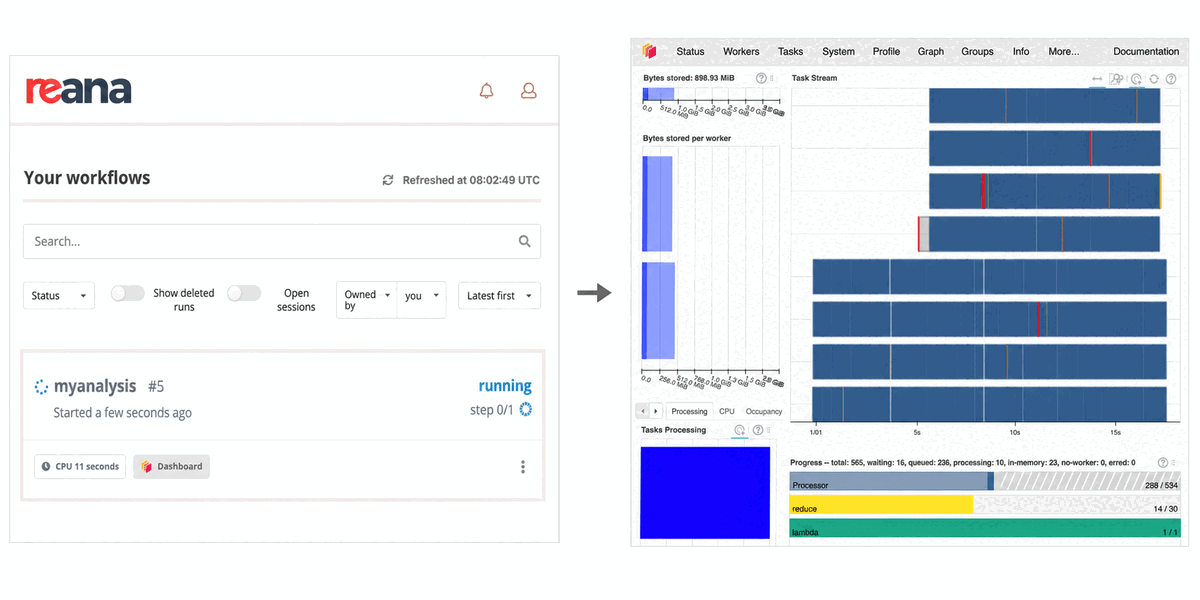
Dask dashboard showing a running REANA workflow

REANA 0.95.0-alpha.5

June 8th 2026

Brings numerous functional and security improvements, including configurable HTCondor resource hints and periodic user quota renewals.

Adds workflow container image vetting and improves access to Dask service logs.

Latest stable release

REANA 0.9.4

December 16th 2024

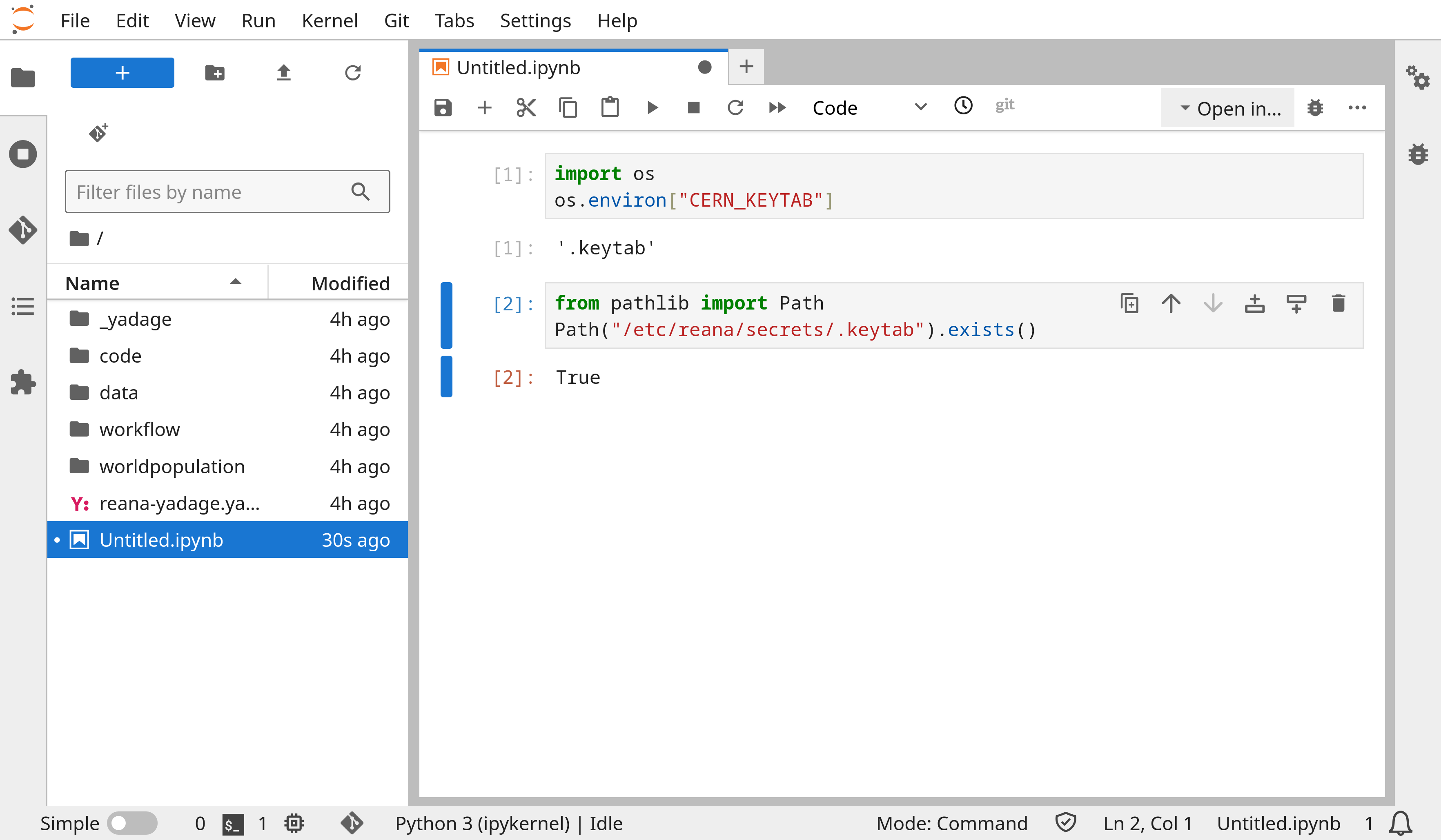
Adds support for user secrets in Jupyter notebook sessions.

Introduces support for Compute4PUNCH infrastructure.

Enhances HTCondor compute backend job dispatch.

Strengthens the security of the platform.

August 25th 2026: The REANA team is hiring two graduate full-stack software developers! Apply by September 9th 2026 at 23:59 Geneva time. [IT-CA-OSI-2026-207-GRAE] [IT-CA-OSI-2026-208-GRAE]
July 7th-8th 2026: Tibor takes part in the EOSC Federation Build-up Group plenary in Brussels, Belgium. [event]
June 24th 2026: Tibor presents the CERN EOSC federated scientific workflows use case at the EOSC Academy Course 3: Use Cases for the EOSC Federation online session. [course]
June 22nd-26th 2026: Alex, Arman, Elena, Michael, Olaf and Tibor take part in the AIP-CERN REANA hackathon. [event]
June 8th 2026: The REANA 0.95.0-alpha.5 development release is published. [release]
May 25th-29th 2026: Tibor presents Reproducible Dask workflows in the REANA reusable analyses platform at CHEP 2026 in Bangkok, Thailand. [event] [poster]
April 27th-30th 2026: Cameron, Michael and Tibor take part in the virtual HSF/IRIS-HEP Analysis Reproducibility training event, leading a reproducible analysis lesson. [event] [lesson]
March 29th 2026: The REANA 0.95.0-alpha.4 development release is published. [release]
March 9th-13th 2026: Cameron participates in the Snakemake Hackathon 2026 in Munich, Germany. [event]
March 5th-6th 2026: Tibor presents Facilitating Open Data Reuse with REANA: From Scalable Workflows to AI-Assisted Analysis Authoring at the 5th DPHEP Collaboration Workshop at CERN. [event] [slides]
February 18th 2026: Tibor presents REANA at the 6th Open Science Practitioners Forum on Analysis Workflows. [event] [slides]
January 9th 2026: The REANA 0.95.0-alpha.3 development release is published. [release]
November 19th-20th 2025: Tibor presents REANA development status and plans at the PUNCH4NFDI Annual Meeting in Potsdam, Germany. [event] [slides]
November 3rd-7th 2025: Cameron and Tibor teach reproducible analysis with REANA at the 2nd CERN School of Computing on IT Services in Ferney-Voltaire, France. [event]
October 7th 2025: The REANA team contributes to two papers published in the CHEP 2024 proceedings: Benchmarking massively-parallel Analysis Grand Challenge workflows using Snakemake and REANA [paper] and LHCb Open Data Ntupling Service: On-demand production and publishing of custom LHCb Open Data [paper].
September 17th-19th 2025: Tibor presents the REANA reproducible analysis platform at the OSCARS Composability & AAI Workshop at CERN. [event] [slides]
September 15th-17th 2025: Tibor presents the importance of computational reproducibility for Open and FAIR Science at Open Science Fair 2025 in Geneva, Switzerland. [event] [slides]
August 26th 2025: Tibor co-authors the ICFA Recommendations for Best Practices for Data Preservation and Open Science in HEP. [paper]
Roadmap

Current

Go client feature parity

Reach feature parity with the Python client across commands, options, and behaviour.

Near-term

JWT and OIDC authentication

Connect REANA to external infrastructures and enable device authorisation for command-line access.

Future

Stable REANA 0.95 release

Conclude the development cycle by stabilising APIs and features for the public REANA 0.95 release.